
Some Definitions
- Fasting: Abstinence from any caloric intake for an extended period of time exceeding 24 hours. It generally includes only water, but some methods allow tea, coffee, and minerals.
- Intermittent fasting (IF): cycles of food consumption that alternate between periods of calorie restriction and periods of no calorie restriction.
- Time-restricted feeding (TRF) is a calorie restriction during a daily time window: 4 to 12 hours.
- Alternate-day fasting: A cycle of complete fasting one day and unrestricted eating the following day.
- Intermittent energy restriction: Alternating days of very low calorie intake (400 to 500 kcal) with days of normal calorie intake.
- 5:2 Diet: Two days of low-calorie intake (no more than 25% of caloric needs) and five days of unrestricted eating.
Pay attention to cardiovascular risk.
A new study published this year raises a warning about time-restricted eating (ART). An 8-year follow-up of over 20,000 American adults showed that those who limited their eating to a period of less than 8 hours per day had a higher risk of cardiovascular mortality compared to those who ate during the typical 12-16 hours per day.
"We observed that people who restricted their eating to a period of less than 8 hours per day had less muscle mass compared to those with a typical eating duration of 12 to 16 hours."
"It is important that patients, especially those with heart problems or cancer, are aware of the positive association between an 8-hour eating window and cardiovascular death," said Zhong, a professor at Shanghai Jiao Tong University.
Other short-term clinical trials have suggested that an 8-hour ART may improve cardiometabolic risk profiles, but the potential long-term effects of this dietary pattern are unknown.
Sean Heffron, a cardiologist at NYU, expressed skepticism about the study's results, calling them "far from complete" and noting that the dietary data were based on only 2 days of dietary records, without correction for confounding variables.
Improvement of type 2 diabetes
Intermittent fasting plus time-restricted feeding was associated with a significant improvement in glucose versus calorie restriction after 6 months, while both interventions were associated with benefits in cardiovascular risk and body composition.
However, the research, published in Nature Medicine, showed that the additional benefit of intermittent fasting did not persist, and less than half of the participants were still following the plan at 18 months, compared to almost 80% of those in the calorie-restricted group.
“In general, people don’t like diets that require them to skip dinner with family/friends on several days of the week,” explained Varady, a nutrition professor in Chicago. “These diets make social eating very difficult, which results in high burnout.”
In an Australian study, results showed that intermittent fasting was associated with improved postprandial glucose and insulin levels and glycated hemoglobin at 6 months, compared to calorie restriction.
At 18 months, 42% of participants in the IF group said they were still doing 2 to 3 days of restrictions per week, while 78% of those who had calorie restriction reported that they continued. Calorie restriction is easier to follow and less likely to cause fatigue.
Fatigue was more common with intermittent fasting plus food restriction, reported by 56% of participants versus 37% of those after calorie restriction at 6 months.
Gut Microbiome
In people with obesity, weight loss through intermittent energy restriction has effects on the brain-gut-microbiome axis, including reduced activity in brain regions that affect eating behavior and increased microbial diversity in the gut, new research suggests.
Circadian rhythms
The body's circadian rhythms influence sleep-wake cycles, eating and digestion patterns, and metabolic processes. Studies suggest that disruptions in these biological rhythms and erratic eating patterns can lead to an increased risk of chronic diseases, including cardiovascular disease (CVD).
Meal timing affects circadian rhythms, and eating late at night may contribute to CVD precursors, such as obesity, more than foods consumed at other times of the day. This may be partly due to the diurnal rhythm of glucose tolerance, which peaks in the morning; some evidence shows that the peak is reduced by time-restricted feeding in the early stages.
Cardiometabolic health
Studies suggest that therapeutic fasting treatments can improve health through multiple pathways, potentially reducing oxidative stress, improving mitochondrial health and DNA repair, and triggering autophagy: a cellular recycling system that removes damaged cells and pathogens, among other actions.
Additional clinical trials have also investigated the impacts of time-restricted feeding. Two of these studies included a six-hour feeding window, from 8 a.m. to 2 p.m. Compared to 12-hour feeding times, the results indicated that time-restricted feeding:
- It lowered fasting glucose levels.
- It altered lipid metabolism and increased fat oxidation.
- Metabolic flexibility increased, defined as the ability to switch between the oxidation of different substrates.
- It increased the feeling of satiety, decreased the urge to eat, and did not impact 24-hour energy expenditure.
Recent meta-analyses that evaluated time-restricted feeding interventions have also suggested that these approaches may have beneficial effects on health parameters such as body weight, fasting blood glucose, and measurements of insulin resistance.
In the figure: comparative study between a diet with
3 meals (3M) and 6 meals (6M) a day.
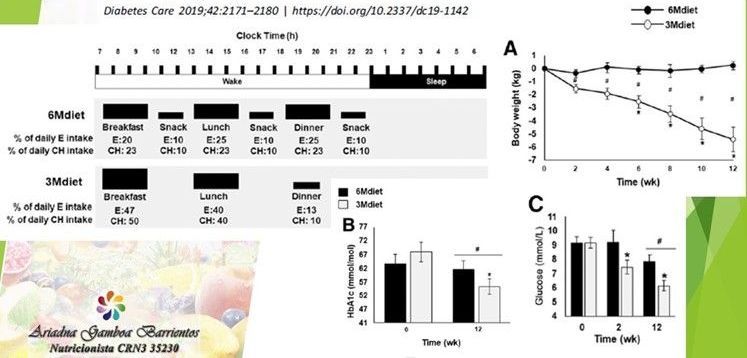
Showing the effects after 12 weeks:
In the reduction of body weight (A), glycated hemoglobin (B) and glucose (C) were higher in the group of 3 meals composed of:
47% of energy at breakfast, 40% at lunch, and 13% at dinner.
Eating disorders
Researchers at the University of Toronto analyzed data from more than 2,700 adolescents and young adults and found that, for women, intermittent fasting was significantly associated with overeating, binge eating, vomiting, laxative use, and compulsive exercise.
For men, intermittent fasting (IF) in the past 12 months was significantly associated with binge exercise and higher overall scores on an eating disorders questionnaire.
Commenting on the findings, Angela Guarda, MD, professor of Eating Disorders at Johns Hopkins School of Medicine, said that intermittent fasting “may help some and harm others and is very likely not healthy for everyone.” She added that “continued research is needed to establish its safety and for whom it may or may not be a therapeutic recommendation.”
Intermittent fasting vs. calorie counting
for weight loss
Time-restricted feeding (TRF) can be a practical and easy way for some people to control their daily food intake and lose weight. It eliminates the need for a person to pay close attention to how much they eat, as long as they restrict consumption to a limited period of time.
"Eating the majority of your daily calories first thing in the morning would have the best cardiometabolic benefit, but reduced adherence would diminish the benefit," said Gabel, a nutrition researcher at the University of Illinois.
She cited a 2022 report as evidence that most people prefer a later eating window. The report reviewed data from nearly 800,000 people, showing that most opted to begin their daily eating between 11 a.m. and 1 p.m., and then stop between 6 p.m. and 8 p.m.
"We know that calorie restriction works. We just need a way for people to do it, and at least for some people, ART is that. Although no evidence clearly shows that 8 hours is the best eating window length, we think 8 hours is a good starting point for motivated people," she said.
ART "may have benefits beyond calorie restriction" that appear to be related to the timing of eating and the extent of the eating window restriction. "Eating earlier is better for markers of metabolic health, regardless of how much weight a person might lose," noted Chow, an endocrinologist and professor at the University of Minnesota.
Sources:
https://doi.org/10.1210/clinem/dgac570
https://doi.org/10.1186/s12986-021-00613-9
https://doi.org/10.1038/s41591-023-02287-7
https://www.jacc.org/doi/10.1016/j.jaccao.2022.03.002
https://doi:10.2196/35896
https://doi.org/10.1016/j.eatbeh.2022.101681
https://www.medscape.com/viewarticle/994720
https://www.ifm.org/news-insights/circadian-fasting-precursors-to-heart-health/
https://doi:10.2196/35896
https://www.medscape.com/viewarticle/intermittent-fasting-linked-higher-cvd-death-risk-2024a1000559
https://www.ifm.org/news-insights/fasting-mitochondrial-health/